
GEO, AIO, AEO, and the Future of AI Search
What are GEO, AIO, and AEO? Why are more people talking about AI search? And why do I think businesses that start working on this now will have a much easier time in the future?
If you ask me, this whole world is basically an extension of SEO, but wider.
GEO, AIO, and AEO are all connected to one thing: helping businesses get mentioned, understood, and recommended by artificial intelligence.
I personally look at it as a new version of online reputation management.
Because today, we already know something very simple. Businesses that rank well in Google, have strong positive mentions on trusted websites, good reviews, and real authority online, usually get much more visibility inside answer engines too.
And that is exactly why this matters.
What do GEO, AIO, and AEO actually mean?
GEO stands for Generative Engine Optimization.
This is the part that focuses on helping your business appear inside AI-generated answers. In simple words, the goal is to make artificial intelligence understand who you are, what your business does, how strong your reputation is, and why you are worth recommending.
AIO is basically the AI adaptation side of things.
That means adapting your website, your content, your structure, and your overall digital presence so AI systems can read your information better, understand it better, and use it better.
AEO stands for Answer Engine Optimization.
This is more about shaping your content so it can become the answer itself. Not just another result in search, but part of the final answer that AI gives the user.
So if I had to explain it simply:
SEO helps you rank in search engines.
GEO helps AI engines recommend your business.
AIO helps your website and content fit the AI world better.
AEO helps your content become the answer itself.

Why does this matter for the future of AI Search?
Because people are clearly changing the way they search.
More and more users are not just typing keywords into Google anymore. They are asking full questions inside ChatGPT, Gemini, Claude, Perplexity, and other answer engines.
And when that happens, the game changes.
Now it is not only about being in the first position.
Now it is about giving the AI enough confidence to say:
this is the business I should recommend.
That is a very different mindset.
In traditional SEO, the goal was often to get traffic from rankings.
In GEO, the goal is bigger. You want to build enough authority, trust, and consistency across the web so the AI can connect the dots and feel safe recommending you.
Why I think businesses should start now
In my opinion, GEO is still in its early stages.
There is still not enough clear data around it, even from very large companies and tools. But at the same time, we can already see movement through website inquiries, AI mentions, visual search, and real user behavior.
And that is exactly why I think businesses should start now.
Right now, it is still easier.
In the future, it is going to be much harder.
That creates a real opportunity today for faster wins, easier visibility, and stronger positioning before this whole space becomes much more competitive.
I can say that from personal experience. I took a website and started building mentions mainly through recommendation articles, and it worked.
So yes, there are still a lot of opportunities in this space right now.
What is the biggest difference between SEO and GEO?
If you ask me, the main difference is very simple.
Today, being in the first position is not enough anymore.
I need to give the AI a final stamp of approval, something that proves I am not just visible, but that I am actually the best recommendation it can give.
That is why I keep saying GEO is an extension of SEO.
Yes, you still need strong rankings.
Yes, you still need strong traditional SEO.
But today, you also need to manage your reputation in the best way possible.
Because AI does not only look at who ranks first.
It tries to understand who looks the most trustworthy, the most professional, the most mentioned, and the most credible.
If content used to be king, today the business itself is king.
How AI search actually works
This is where many people still do not understand what is happening.
AI does not just pull one result and stop there.
It looks for cross-verification.
For example, if someone asks for the best lawyer in a specific field, the AI may first check search results, then look at Google reviews, then look for an English source, then check a directory, then maybe look at articles or brand mentions, and only after that return a strong final answer.
That means one thing very clearly:
It is not enough to have only a good website.
You also need reviews.
You need mentions.
You need articles.
You need directories.
You need external sources.
You need clear authorship.
You need trust signals.
Because if AI is checking you from different angles, you need to be strong from different angles too.
What businesses should actually do
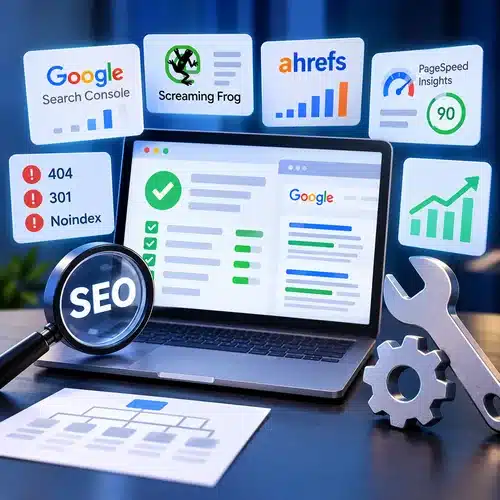
If I start working on GEO for a business, the first thing I do is check whether the site is technically accessible to AI systems.
Sometimes the problem is very simple. The website may already rank well in Google, but AI bots are blocked.
I check robots.txt.
I check llms.txt.
I check whether there is a sitemap.
I check whether Cloudflare or hosting settings are blocking access.
I check the structure, the schema, and the overall technical foundation.
Only after that do I move to the deeper work.
Then I build broader research.
I look at regular search keywords for Google, but I also look at AI-style questions with the same intent.
For example, instead of just targeting a keyword like criminal lawyer, I also want to understand questions like:
Who is the best criminal lawyer?
Recommended criminal lawyer in Israel
Which law firm should I trust for this case?
Then I do source research.
Where is the AI pulling information from?
Is it pulling from English pages?
From Google Business?
From a strong directory?
From news coverage?
From the main site itself?
That part matters a lot.
Because the more places your business appears in a strong and consistent way, the more likely AI is to mention you.
What kind of content works better for AI?
In my opinion, content for AI needs to be clearer, deeper, and easier to process.
That usually means:
More mentions.
More tables.
More question-and-answer sections.
More depth around your specialty.
Better author pages.
Stronger About pages.
Better schema.
Clear case studies.
Real proof.
The goal is very simple: make it easy for AI to understand who you are and why you deserve to be recommended.
Because if there is no proof, no depth, no reputation, and no strong brand signals, it becomes much harder for the system to trust you.
Why traditional reputation management is now part of GEO
Years ago, people used to call some of this reputation management.
And honestly, a lot of it still is.
Because what are we really doing here?
We are helping AI understand:
Who the business is
How good the business is
Who stands behind it
What people say about it
Where it is mentioned
And whether it deserves trust
So yes, GEO is connected to SEO. But it is also connected to reputation, brand authority, PR, trust, and consistency across the web.
That is why I do not see it as some tiny side tactic.
I see it as part of the next stage of search.
The biggest mistake businesses make
The biggest mistake, in my opinion, is that many business owners still have not fully realized what is happening.
They still do not understand that people are already searching inside AI tools.
And because of that, many of them are late.
The second problem is that they listen to people who do not really understand SEO, but suddenly call themselves GEO experts because it sounds trendy.
I see this online all the time.
That is exactly why businesses need to be careful.
GEO is not just another trendy word.
It is not just a nice-looking acronym.
And it is definitely not something you can fake with a few buzzwords.
It requires real understanding of SEO, site structure, content, authority, trust signals, and the way AI systems actually learn and recommend.
So what should a business owner do right now?
If you ask me, every business owner should talk to an SEO expert who also understands GEO.
Ask for a clear plan.
Ask what they are going to do.
Ask how they measure progress.
Ask what kind of AI adaptation they actually make.
Because right now, most business owners still hear words like GEO, AIO, AEO, and AI Search, but they do not really understand how it connects to their business in practice.
And that is exactly where a real expert comes in.
A business owner should not guess.
They should understand:
what they are getting
how it works
and why it matters now
Final thoughts
GEO, AIO, and AEO are not here to replace SEO.
They are here to expand it.
Search is changing.
Users are changing.
And the way businesses get discovered is changing too.
That is why the future of AI search will not belong only to businesses that rank well.
It will belong to businesses that are understood well, trusted well, and mentioned well across the web.
And if you ask me, that is exactly why this matters now more than ever.