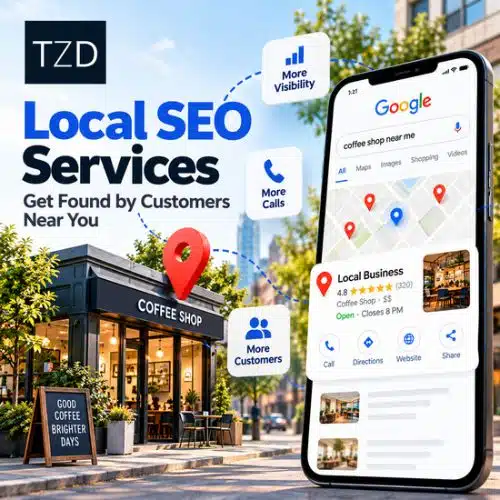
Local SEO Services: How to Get Found by Customers Near You
You have a great business, happy customers, and a service you genuinely believe in. But what happens when someone just a few blocks away searches Google for exactly what you offer?
That is where Local SEO comes in.
Local search engine optimization helps businesses improve their visibility in location-based Google searches and turn that visibility into phone calls, appointments, store visits, and paying customers.
In this guide, I will walk you through the practical side of local SEO: how to optimize your Google Business Profile, which pages to build on your website, how to collect customer reviews the right way, and what you should measure to know whether your local SEO efforts are actually helping your business.
Local SEO: A Practical Guide for US Businesses
What Is Local SEO?
Local SEO is the process of improving a business's visibility in searches where location matters.
For example:
- Emergency plumber in Austin, TX
- Personal injury lawyer in Miami
- Hair salon near me
- Italian restaurant in Brooklyn
Customers do not always include a city or neighborhood in their searches. Sometimes they simply search for "coffee shop" or "electrician," and Google uses location signals to provide relevant local results.
Your business may appear in Google Maps, the local map results shown in Google Search, and the organic results that lead to your website.
One thing is important to understand: your Google Business Profile and your website are two separate assets. A good local SEO strategy works on both and creates a clear connection between them.
Which Businesses Need Local SEO?
Local SEO is especially relevant for businesses where location or service area influences a customer's decision.
This includes:
- Law firms and attorneys
- Medical and dental practices
- Restaurants and coffee shops
- Fitness studios and gyms
- Home service businesses
- Local retail stores
- Businesses serving multiple nearby cities
A business serving several cities can also benefit from local SEO. The important questions are where you actually operate, which services you provide in each area, and whether attracting customers from those locations makes financial sense.
Example: If you own an HVAC company serving Austin, Round Rock, and Cedar Park, you should research demand and competition in each location.
There is no reason to invest heavily in ranking for an area where you rarely accept jobs or where travel costs make the work unprofitable.
On the other hand, an online-only business with no in-person customer contact is generally not eligible for a Google Business Profile. It can still invest in organic SEO, but its strategy should reflect how the business operates.
Local SEO vs. Traditional SEO: What Is the Difference?
Both focus on search visibility, but local SEO places additional importance on the business's location and the searcher's location.
| Factor | Traditional SEO | Local SEO |
|---|---|---|
| Target audience | Based on topic, needs, and search intent | Based on search intent and location |
| Search examples | How to choose an air conditioner | AC repair in Dallas |
| Main assets | Website and content | Website and Google Business Profile |
| Important information | Guides, solutions, and comparisons | Address, hours, service areas, and contact information |
| Desired actions | Inquiries, signups, and purchases | Calls, directions, appointments, and visits |
In practice, these strategies work together.
A technically sound website with useful content can support your local presence, while an accurate Google Business Profile can help customers reach the right service page.
How Does Google Rank Businesses in Local Search?
Google identifies three main factors that influence local rankings:
Relevance: How closely your business matches what someone is searching for. Complete and accurate business information helps Google understand your services.
Distance: How far your business is from the searcher's location or the location specified in the search.
Prominence: How well-known your business is. Google considers signals such as links from other websites, reviews, and positive ratings.
You cannot pay Google to improve your organic local ranking.
What does this mean for your business?
You can improve your business information, relevance, and online presence, but you cannot guarantee a number-one position from every location in a city.
That is also why local SEO performance should be measured across relevant locations, rather than through a single search from your office computer.
How to Improve Your Local SEO: 5 Practical Steps
1. Research What Customers Search for in Your Area
Start by combining your services with relevant locations.
For example:
- Roof repair in Tampa
- Divorce attorney in Chicago
- Personal trainer in San Diego
- Emergency dentist in Phoenix
Then research the questions customers ask before contacting a business, including pricing, availability, parking, and service details.
Do not select keywords based only on search volume.
A highly specific search that brings the right customer can be more valuable than a broad keyword that generates traffic without inquiries.
Practical tip: Review customer messages, phone calls, and frequently asked questions. The language your customers actually use is an excellent starting point for keyword research.
2. Optimize Your Google Business Profile
Your Google Business Profile should answer three basic questions:
What does your business do? Where does it operate? How can customers contact you?
Make sure your business name, primary category, phone number, website, and business hours are accurate.
Add relevant services and authentic photos that help customers understand what to expect.
Use your real business name rather than adding unnecessary keywords to it.
If you travel to customers and do not receive them at your business address, follow Google's rules for hiding the address and setting service areas.
Do not create additional business profiles for every city simply because you want to rank there.
3. Create Useful Location Pages on Your Website
A good local landing page explains which services you provide in a particular area, who they are for, and how customers can get started.
For example, a Pilates studio in San Diego might include:
- Available class types
- Information for beginners
- Location and parking details
- Class schedules
- Options for booking an introductory session
You do not need a separate page for every city.
Create location pages when you have genuinely useful, location-specific information to offer.
Simply replacing one city name with another across dozens of pages does not create value for the reader.
Include the service and location naturally in headings and content, and connect location pages to your main service and contact pages.
If your website runs on WordPress, it is also worth reviewing its technical SEO structure.
4. Build Trust With Customer Reviews and Local Mentions
Ask customers to leave honest reviews after receiving your service.
You can make the process easier by sharing a direct review link.
Do not offer discounts, gifts, or other incentives in exchange for reviews.
Respond to reviews professionally and address legitimate customer concerns.
You should also look for opportunities to appear on relevant websites, such as:
- Local business associations
- Industry organizations
- Community websites
- Relevant local publications
- Business partners
Choose websites that your potential customers might genuinely find useful.
Keep your business information consistent wherever it appears. An outdated phone number or incorrect address can cost you a customer.
5. Make It Easy to Contact You and Measure Results
Open your website on a mobile phone.
Can visitors immediately understand what you offer and where you operate?
Can they call you with one tap?
Does the contact form work?
Is the website fast enough to use comfortably?
Then measure what happens.
Track website visits, relevant inquiries, phone calls, appointments, and customers who actually purchase your services.
Google Business Profile performance data and Google Search Console can help you understand how customers find your business.
A CRM or organized lead-tracking process can help you understand which inquiries turn into paying customers.
Remember: A click on a call button does not necessarily mean a phone conversation took place.
The real business goal is to generate qualified inquiries and convert them into customers.
How Long Does Local SEO Take to Show Results?
There is no single timeline that applies to every business.
Results depend on your starting point, the condition of your website and Google Business Profile, local competition, your existing reputation, and the amount of work required.
Correcting an outdated phone number or inaccurate business hours can help customers as soon as the changes become visible.
Consistent improvements in rankings and qualified inquiries generally require ongoing work over time.
I recommend documenting your starting position and evaluating progress over several months rather than making decisions based on one week of data.
Common Local SEO Mistakes to Avoid
Creating unnecessary business profiles: Serving customers in another city does not automatically justify creating another Google Business Profile.
Duplicating location pages: Replacing city names without providing unique local information does not help customers make a decision.
Ignoring business hours and contact information: A customer who calls the wrong number or arrives when your business is closed may choose a competitor.
Focusing only on review quantity: Reviews matter, but so do customer experience, accurate information, and convenient contact options.
Targeting unprofitable service areas: Before investing in rankings, make sure the customers you attract are worth serving.
Checking rankings from one location: Local results vary depending on location and context. One search does not provide a complete picture.
Reporting rankings without business outcomes: Rankings are useful, but you should also connect them to inquiries, lead quality, and sales.
A Practical 90-Day Local SEO Plan
The following is a working framework, not a guarantee that rankings or leads will improve within 90 days.
| Timeline | Main Activities | Expected Deliverable |
|---|---|---|
| Days 1–30 | Audit the website and Google Business Profile, research local keywords, and document existing performance | Baseline report and prioritized action plan |
| Days 31–60 | Improve service and location pages, update business information, and optimize contact options | Better local content and a more organized online presence |
| Days 61–90 | Review lead quality, expand relevant content, and strengthen local visibility | Data-driven recommendations for the next stage |
Do not wait until the end of the 90 days to fix urgent problems.
If your contact form is broken or your Google Business Profile displays the wrong phone number, address the issue immediately.
Frequently Asked Questions About Local SEO
Is local SEO worth it for small businesses?
Yes, especially when customers search for products or services in a specific city or service area. The important question is whether those searches can bring qualified customers to your business.
Do I need a Google Business Profile for local SEO?
An eligible business can benefit significantly from an accurate Google Business Profile. However, local SEO also includes website content, technical optimization, and relevant online mentions.
Can I rank in cities where my business has no office?
You may be able to attract organic website traffic from nearby cities you genuinely serve. However, you should not create fake offices or additional Google Business Profiles simply to rank in those locations.
How many location pages should I create?
There is no fixed number. Create pages when each location has meaningful, unique information that helps customers. Avoid generating large numbers of nearly identical pages.
How much does local SEO cost?
Costs vary depending on your industry, local competition, number of locations, website condition, and required services. A business operating in one small area may need a different strategy from a company serving multiple competitive markets.
Can local SEO guarantee first place on Google Maps?
No. Local rankings depend on relevance, distance, prominence, and other contextual signals. No legitimate SEO provider can guarantee first place for every search and location.
Final Thoughts: Help Local Customers Find Your Business
Start with a simple question:
When someone in your area searches for the services you offer, can they clearly understand what your business does, where you operate, and how to contact you?
From there, focus on keyword research, accurate business information, useful local content, and measuring the inquiries that matter.
Local SEO is not just about appearing on Google Maps. It is about connecting your business with customers who are already looking for what you offer.
Want to understand where your business should focus first?
Contact TZD SEO and tell us about your services, locations, and business goals so we can help you build the right local SEO strategy.